Aditi Montessori · Chandanagar

Sensorial Activities

Refining the senses to build clear thinking.

Activities

Learning begins with the senses

Cylinder blocks, the pink tower, color tablets, and more help children refine perception and build the foundations of later learning.

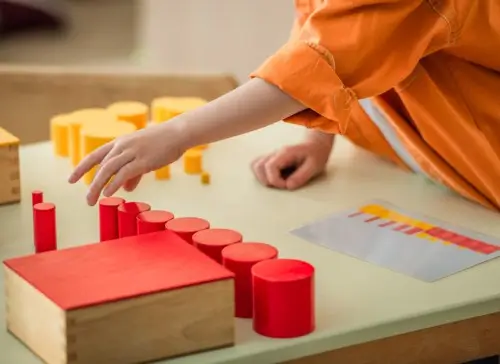
Cylinder Blocks

Cylinder Blocks

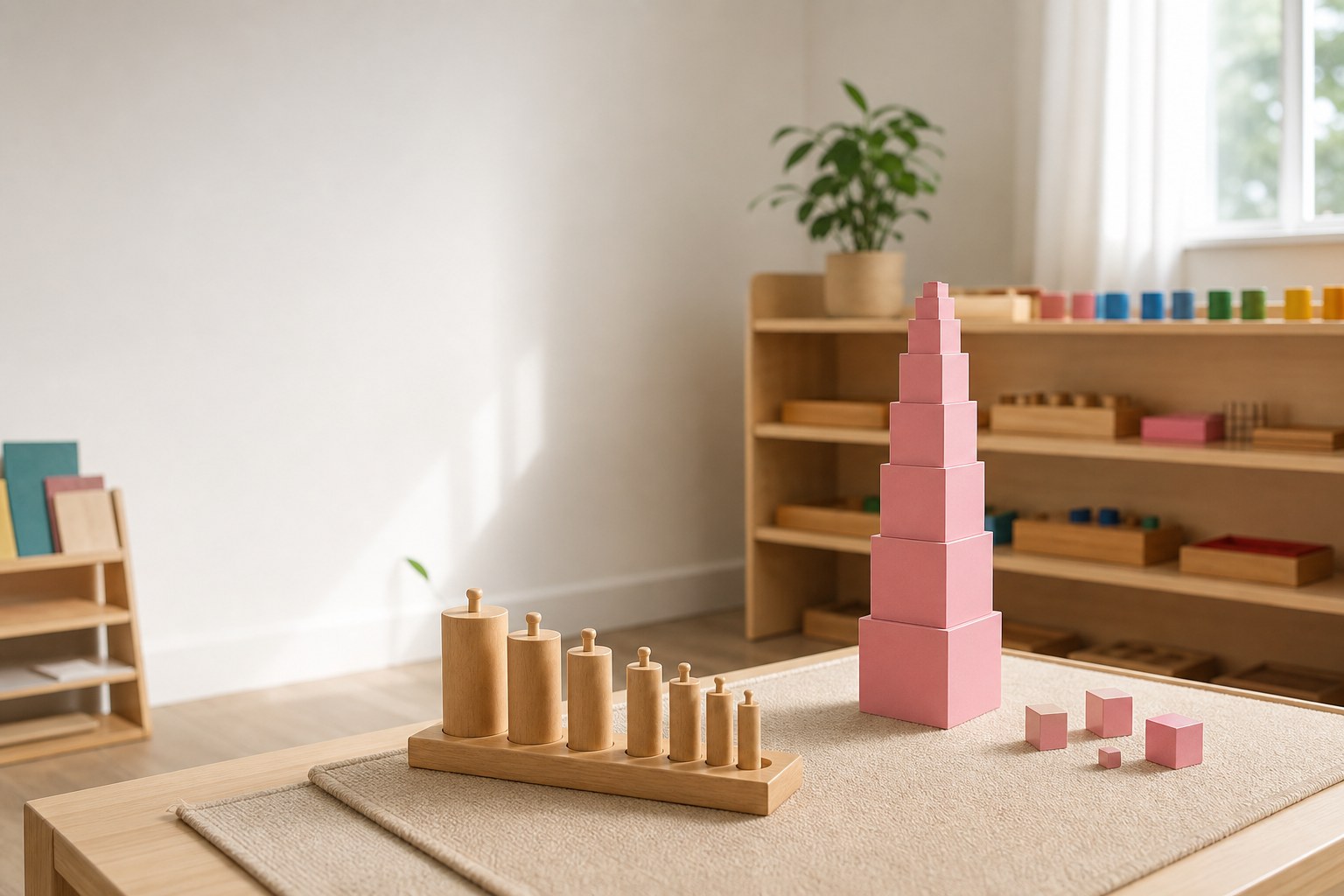
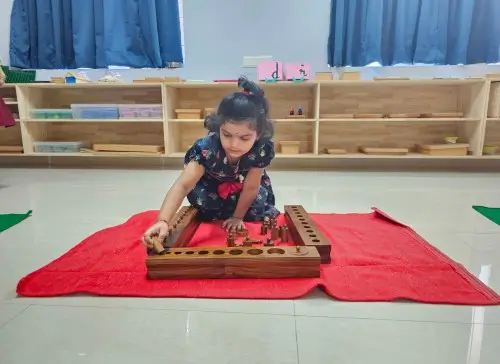
Children can sort the cylinders by size or dimension, developing their understanding of measurement and comparison.Children can transfer the cylinders from one block to another, developing their fine motor skills and hand-eye coordination.
Pink Tower

Pink Tower

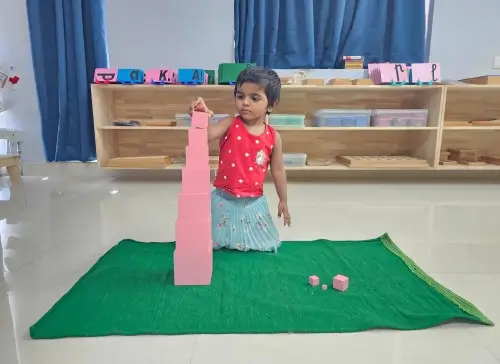
Children can stack the cubes from largest to smallest or smallest to largest, developing their understanding of size and dimension and their fine motor skills.Children can compare the size of the cubes to one another, identifying which cube is bigger or smaller, and sorting them by size.

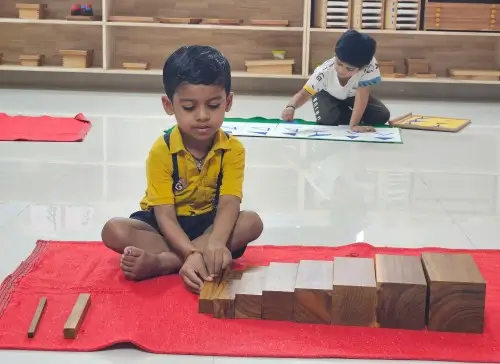
Brown Stairs

Brown Stairs

Children can explore the prisms by stacking them, building structures, and arranging them in different patterns, developing their creativity and imagination.By this activity developing a child's spatial and visual perception, fine motor skills, and vocabulary, while also encouraging independent learning and exploration.

Long Stairs

Long Stairs

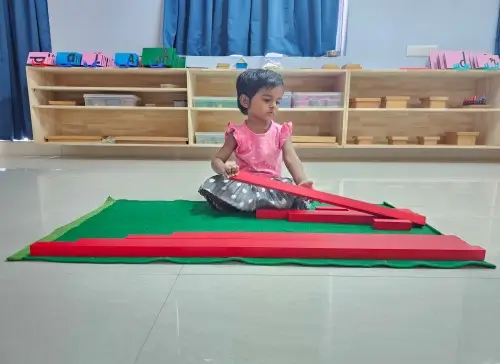
Long Stairs is a valuable tool in Montessori education for developing a child's understanding of size and dimension, as well as basic math concepts and vocabulary. The use of varying shades of blue also helps to develop a child's visual discrimination skills and perception of colors.

Color tablets

Color tablets

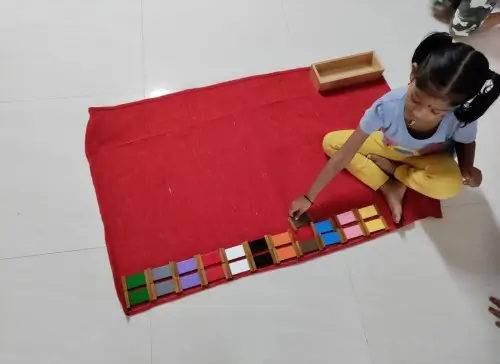
Children can learn the names of different colors, shades, and tones, developing their language and communication skills.Children can use the color tablets to create different color compositions and explore their creativity.

Tactile material

Tactile material

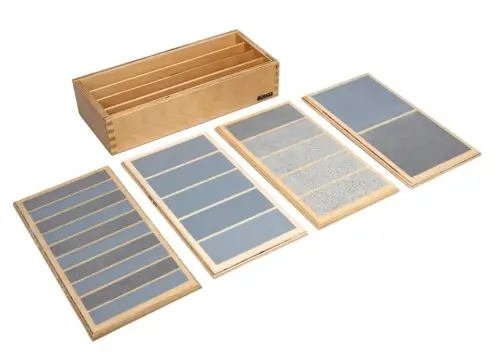
children can sort objects by texture, shape, or size, developing their cognitive and organizational skills.

Noise Boxes

Noise Boxes

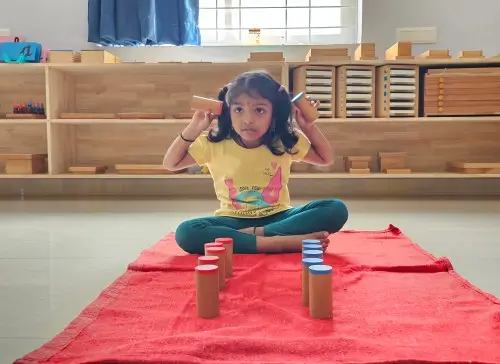
These boxes contain miscellaneous items, such as buttons, shells, or rocks, that make a distinct sound when shaken. Children learn to recognize the different sounds and distinguish them from one another.

Geometrical Cabinet

Geometrical Cabinet

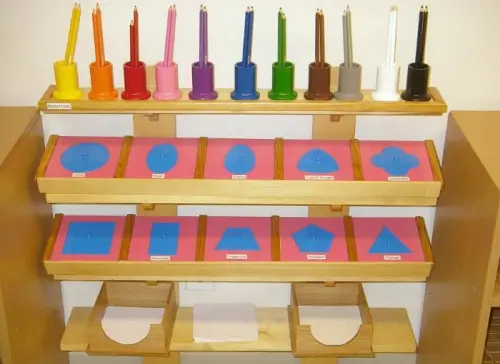
Children can trace the shapes with their fingers or pencils, developing their fine motor skills and hand-eye coordination and can use the shapes to create patterns, designs, and three-dimensional structures, developing their spatial reasoning and imagination.

Geometrical Cards

Geometrical Cards

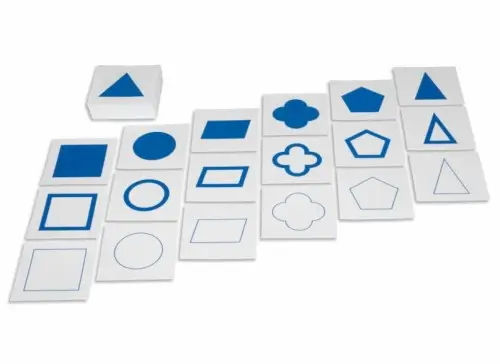
Children can match the cards to the corresponding shapes in the Geometrical Cabinet or other Montessori materials, developing their visual perception and matching skills.

Superimposed Figures

Superimposed Figures

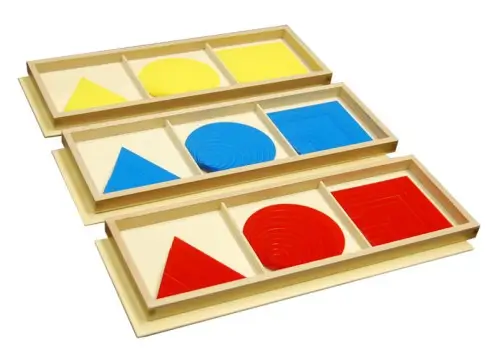
Montessori Superimposed Figures is a versatile and engaging tool for learning and exploring different geometric shapes, colors, and transparency. It helps children develop their visual perception, color theory, spatial reasoning, creativity, and imagination, while also encouraging exploration and discovery.

Binomial Cube

Binomial Cube

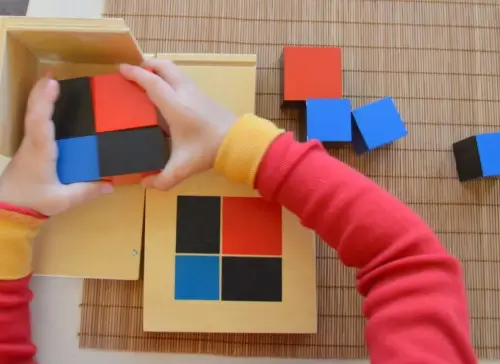
Binomial Cube is a valuable tool for teaching children about spatial relationships, geometry, and algebraic principles. It helps children develop their fine motor skills, hand-eye coordination, visual perception, spatial reasoning, creativity, and problem-solving abilities.

Trinomial Cube

Trinomial Cube

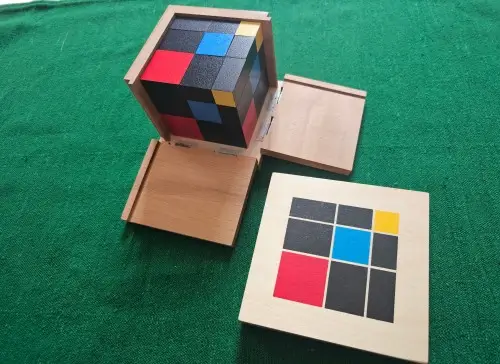
Trinomial Cube is a valuable tool for teaching children about spatial relationships, geometry, and algebraic principles. It helps children develop their fine motor skills, hand-eye coordination, visual perception, spatial reasoning, creativity, and problem-solving abilities, while also encouraging exploration and discovery.

Decanomial Square

Decanomial Square

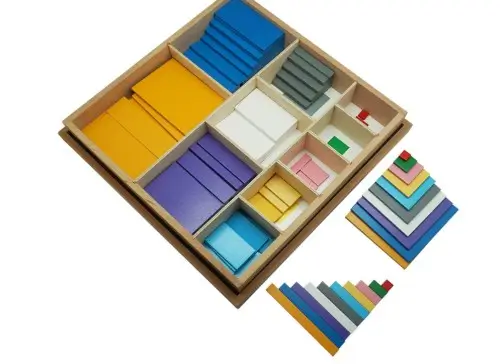
Decanomial Square is a valuable tool for teaching children about multiplication, squares, and square roots. It helps children develop their mathematical skills, creativity, and imagination, while also encouraging exploration and discovery.

Constructive Triangles

Constructive Triangles

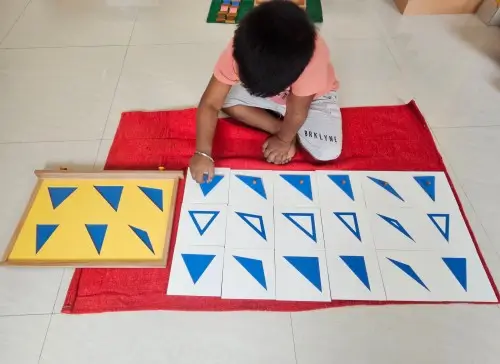
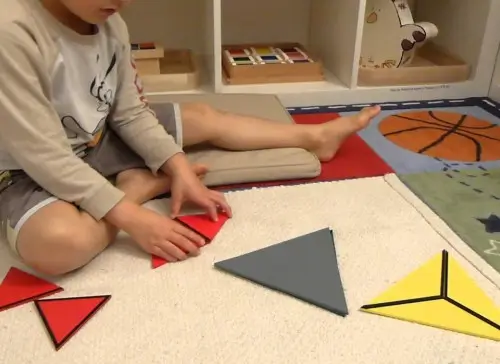
Children can compare the different triangles to discover their similarities and differences, developing their visual perception and discrimination skills and also Children can explore the different geometric shapes and patterns that can be created with the triangles, developing their spatial reasoning and imagination.Children can use the triangles to create their own designs and structures, developing their creativity and problem-solving skills.

Geometrical Solids

Geometrical Solids

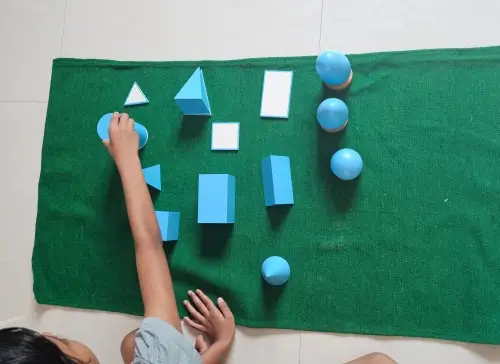
Children can classify the solids according to different criteria, such as shape or color, developing their organizational and categorization skills.Children can learn the names and properties of the different geometric shapes, developing their language and communication skills.

Stereognostic bags

Stereognostic bags

Stereognostic Bags are a set of cloth bags that contain different objects of varying shapes, sizes, and textures. The bags are designed to help children develop their sense of touch, or tactile sense, and to learn to recognize and identify objects by touch alone.

Colored Cylinders

Colored Cylinders

Children can match the cylinders to their corresponding holes in the wooden base, developing their hand-eye coordination and visual discrimination skills.Children can stack the cylinders according to size, height, or color, developing their fine motor skills and visual discrimination skills.

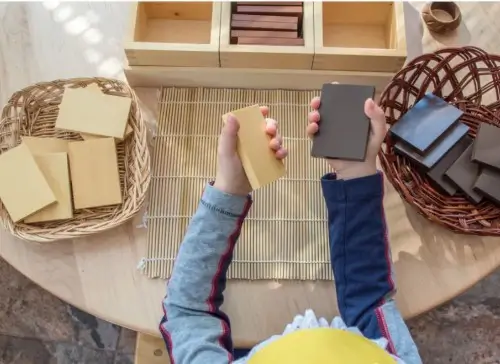
Baric Tablets

Baric Tablets

Children can learn the names and properties of the different weights, developing their language and communication skills.

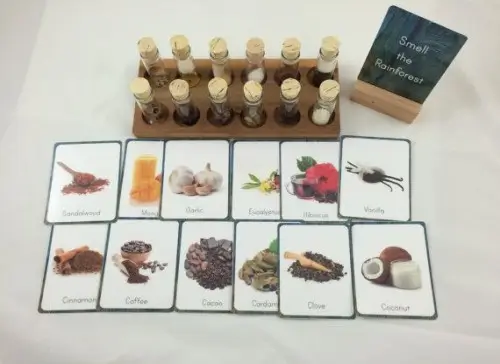
Olfactory Activities

Olfactory Activities

Olfactory Activities are a valuable tool for developing children's sense of smell, promoting concentration and focus, developing their ability to discriminate and classify different scents, and encouraging observation and discussion skills.

Gustatory Activities

Gustatory Activities

Gustatory Activities are designed to help children develop their sense of taste and ability to identify different flavors. The sense of taste is an important part of our sensory system and can have a significant impact on our overall wellbeing and dietary choices.

Drawing insets

Drawing insets

Drawing Insets are a valuable tool for developing children's fine motor skills, hand-eye coordination, artistic abilities, creativity, and problem-solving skills.